
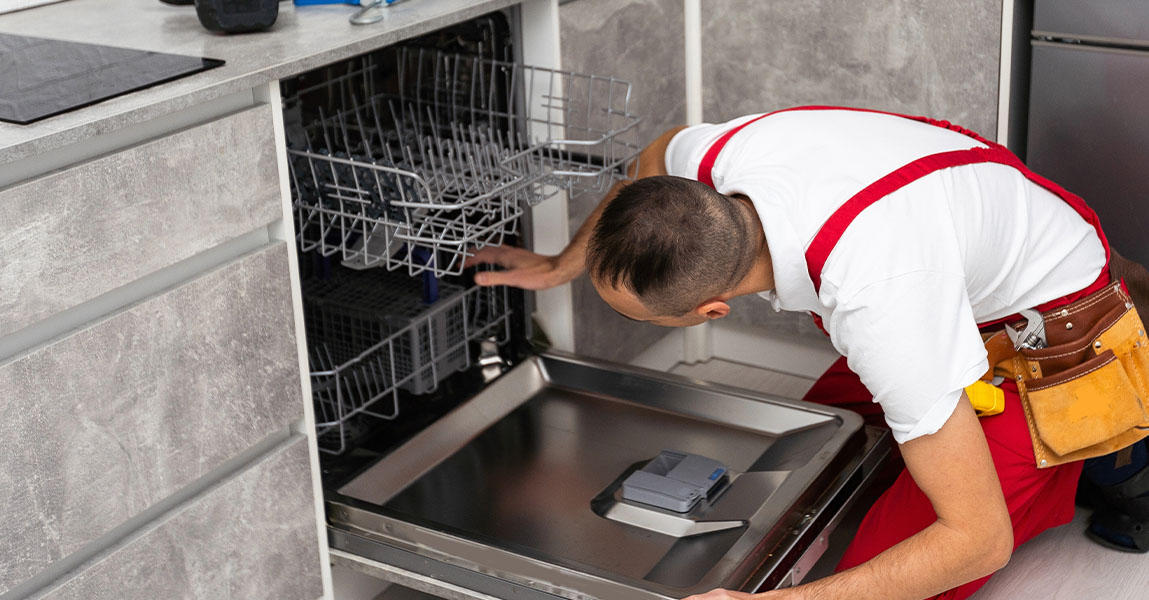
When a dishwasher fills and hums but never sprays water, it often catches people off guard. We expect it to start cleaning once the cycle begins. However, several internal parts must work together to deliver water with enough pressure through the spray arms. If something fails, the machine may still run but leave dishes dirty. Understanding what controls the spray function helps narrow down the real cause. We’ll walk through the possible failures step by step and explain what to look for.
Spray Arms Not Spinning or Spraying: Obstruction or Water Pressure Problem
Something may block the spray arms or prevent them from spinning freely. In many cases, dried food, grease, or broken bits from dishes fall into the spray holes. These clogs stop water from flowing evenly. That reduces pressure and causes weak or no spray. If the spray arms cannot rotate, water will not reach all racks, and the spray becomes uneven or stops completely.
To check, we remove the lower and upper spray arms by hand. We inspect the holes and rotate each arm. If it moves stiffly or has buildup, we soak it in hot water and vinegar, then clean each hole with a toothpick. After that, we reinstall the arms and test again. In some cases, the arms warp over time or crack at the center hub. When this happens, they must be replaced.
Circulation Pump Failure: Motor Runs, but Water Doesn’t Move
Even when the dishwasher sounds like it’s working, the pump may fail to push water with force. Most dishwashers use a circulation motor that spins an impeller. That impeller draws water through the filter and pushes it up to the spray arms. If the impeller breaks or the motor weakens, water pressure drops. As a result, the spray arms receive no water at all.
To find out if the motor or impeller failed, we listen for unusual sounds like humming with no movement. Next, we remove the filter and check for broken parts in the impeller housing. In some models, the impeller detaches from the motor shaft. In others, debris jams the impeller blades. If the motor struggles to start or cuts out early, it could be a sign of electrical failure inside the windings. In both cases, a full motor replacement may be necessary.
For more help diagnosing these types of internal failures, visit our guide to dishwasher repair in St Albert.
Water Inlet Valve Issues: Machine Fills, but Not Enough Pressure for Spray
The inlet valve brings water into the dishwasher at the start of each cycle. While it may allow some water in, a weak valve can reduce pressure. If the valve only opens partially, the machine might fill slowly or not reach the correct water level. This leads to poor circulation and little or no spray from the arms. A slow fill also delays heating and extends cycle times.
To check this, we open the front panel and monitor the water flow when the cycle starts. If the water trickles in or stops early, we inspect the inlet valve screen for debris. Mineral buildup and rust often clog the screen or jam the solenoid. Cleaning helps in minor cases. However, if the valve buzzes loudly or leaks, it needs replacement.
If your dishwasher hums but doesn’t seem to fill or circulate correctly, it may be time to consider appliance repair in St Albert.
Float Switch or Water Level Sensor Not Working Correctly
The float switch detects how much water is inside the tub. If it thinks the dishwasher is full when it’s not, it shuts off the inlet valve early. In this case, the machine will start running without enough water. The spray arms may turn, but no water sprays out. The float itself can get stuck due to hard water buildup or trapped food.
We lift the float gently and make sure it moves freely. Underneath, we inspect the float switch with a multimeter to check for continuity. If the switch sticks open, it must be replaced. Some dishwashers use electronic sensors instead of mechanical floats. These sensors fail when corroded or blocked by residue. Cleaning around the sensor often restores proper function.
When water levels seem too low for effective spray, float switch testing becomes a priority.
Blocked Filter or Sump Area Prevents Water From Reaching Pump
Every dishwasher includes a filter system that traps food before it enters the pump. Over time, the filter can clog completely. When this happens, water cannot reach the circulation pump. Even though the machine fills and drains, the spray function does nothing. In many cases, the pump hums but moves no water.
We remove the bottom rack and pull out the filter screen. If it’s covered in sludge or grease, we soak it in hot soapy water and scrub both sides. Underneath the filter is the sump. This basin collects water before it moves into the pump. We check it for broken glass, labels, and thick buildup. In some designs, a grinder or macerator breaks down food. These parts also get jammed or worn.
Cleaning this area improves water flow dramatically and often restores spray pressure quickly.
Failed Diverter Valve Prevents Water From Reaching the Spray Arms
On some dishwashers, a diverter valve directs water to specific spray arms during the cycle. If this valve sticks or the motor fails, it may block all water flow. That leaves one or both spray arms dry throughout the wash. The machine continues to run, but nothing actually gets cleaned.
To test this, we listen for the sound of the diverter motor during spray changes. If it clicks or buzzes without movement, the motor may be faulty. In other cases, the valve gets blocked by food bits or warps from heat. When stuck in the closed position, it cuts off water from both arms.
Replacing the diverter valve or motor assembly often restores full circulation.
Control Board or Sensor Error Prevents Spray Cycle from Starting
The dishwasher’s control board coordinates when to open valves, run the motor, and activate spray cycles. If the board fails or receives bad sensor data, it may skip or cancel spray commands. This kind of failure does not always trigger error codes. Instead, the machine fills and hums but remains ineffective.
To verify control issues, we run a diagnostic cycle. This checks each component step by step. If the spray pump never engages during the test, or if it cuts off quickly, the board may need repair. We also check the wiring harness and connections at the pump. Loose plugs or damaged wires can prevent proper operation.
In cases where the dishwasher behaves strangely, control logic problems are worth exploring.
For help with electronic failures, visit appliance repair services in St Albert.
Drain Valve Stuck Open Causes Water Loss During Spray
Although less common, a stuck drain valve can open during a spray cycle. When this happens, water escapes from the tub before it can build pressure. The dishwasher fills and starts, but the pump draws from an empty sump. No spray reaches the arms even though the motor runs.
We inspect the drain valve to ensure it closes fully between drain and spray cycles. If it’s stuck in the open position, we check for debris or worn springs. Solenoid-driven valves sometimes fail from heat or corrosion. Replacing a faulty valve restores water retention and spray pressure.
When water seems to vanish before spraying starts, we always inspect the drain system.
Call for Help When DIY Fixes Don’t Solve the Problem
Sometimes we check every part and still can’t get the dishwasher to spray properly. In those cases, experience and proper tools make the difference. Problems like intermittent power, low voltage, or a failing motor capacitor can be hard to catch without testing. If your dishwasher runs but does nothing useful, it’s best to have a technician take a closer look.
For reliable troubleshooting and service, reach out to contact JAY Appliances. We can help restore full spray pressure, clean performance, and quiet operation.
Frequently Asked Questions
Why does my dishwasher make noise but not spray water?
It may have a blocked spray arm, failed pump motor, or low water level. These issues stop water from circulating properly.
Can dirty filters stop spray arms from working?
Yes, clogged filters prevent water from reaching the pump, which leads to weak or no spray output.
Is it safe to run a dishwasher if the spray arms are not moving?
Running it without proper spray does not clean dishes and may damage the pump over time due to poor water flow.
How do I test if the circulation pump is working?
Start the cycle, wait for the spray phase, and listen for water whooshing sounds. A quiet hum with no spray usually signals pump failure.
Should I replace a dishwasher that doesn’t spray anymore?
Not always. Many spray failures come from simple clogs or stuck valves, which are cheaper to fix than buying a new unit.